
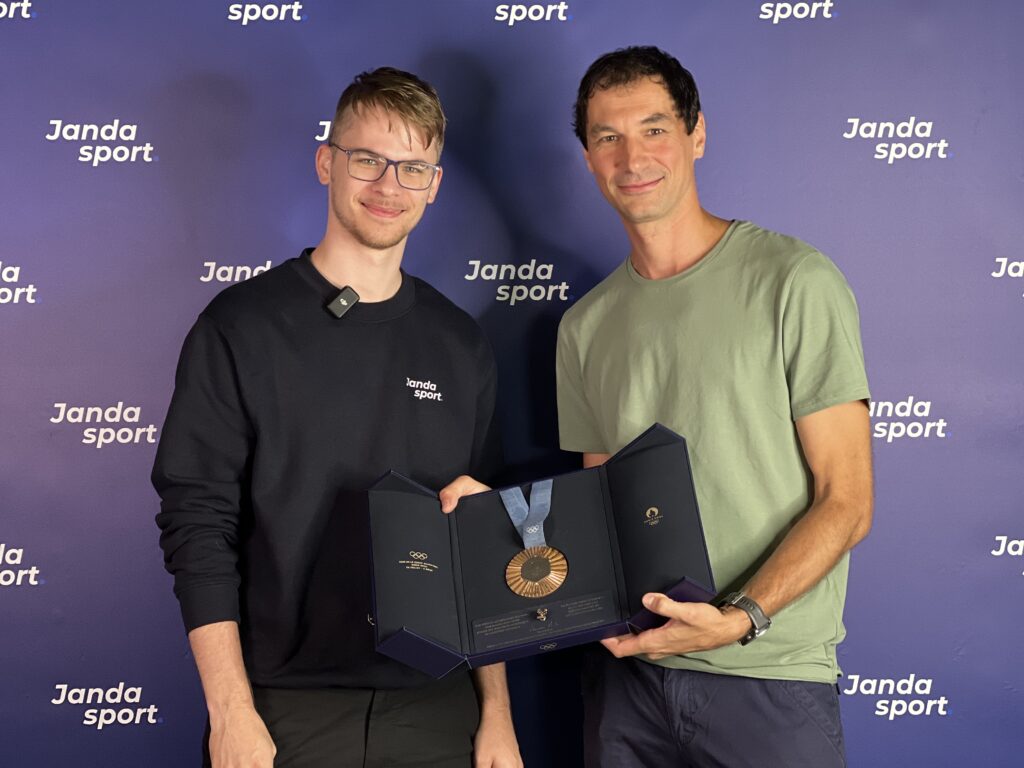
Jiří Beran is one of the biggest names in Czech fencing. His career peaked with team épée bronze at the Paris 2024 Olympics. He inspires not only with his results but with his approach to training and to working with younger fencers.
How would you introduce fencing to people who don’t know much about it?
In short: the épée and the foil are thrusting weapons, so the aim is to hit your opponent with the point.
A fencer dressed all in white is an épéeist. You can hit your opponent anywhere, from the toes to the head. At the tip of the weapon is a button that closes an electrical circuit; when you land a hit it activates and the scoring machine registers the touch.
A foilist wears a lamé vest, and the vest is the target area. Hitting anywhere else is off-target. The foil has nothing special at the tip – the circuit closes when the blade touches the opponent’s electric vest.
How can a hobbyist get into fencing?
Join a club. Professionals and hobbyists train side by side, so there’s nothing to be afraid of. Fencing is very fast and physically demanding, but you can do it at a high level well into later life.
What role does technology play in fencing?
A big one – the rules even change because of technology.
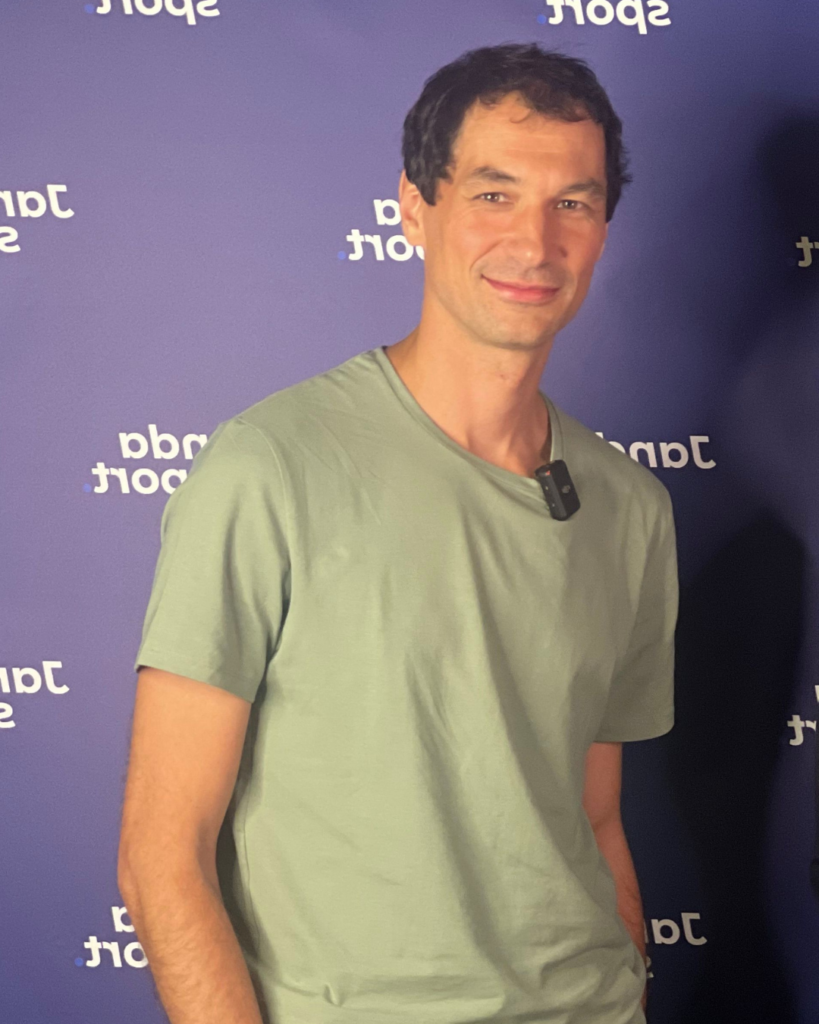
Jiří Beran
A Czech fencer whose achievements include:
- Czech épée champion,
- 2× European Championship bronze,
- multiple international tournament winner,
- 2007 World Cup winner,
- bronze at the Paris 2024 Olympics.
Can you share some behind-the-scenes stories from the Olympics?
Pretty much the whole Olympics is behind the scenes. The media aren’t allowed into the village, or get just a day or two to shoot interviews there for a few hours. The village is a safe haven where athletes can focus and rest.
There are plenty of experiences, but there could be more. At the Olympics athletes go home within 48 hours of competing. We were due to fly out at 6 a.m. the next day, so we went to the tournament with our bags packed. In the end they rebooked our flight by a day so we could do our media duties.
I briefly went to watch BMX and skateboarding, but there isn’t much time. What I enjoyed most was being together with other athletes – the energy is amazing.
A photo of an Italian swimmer sleeping outside on a bench went viral. Was sleeping in the Olympic village really that bad?
Not to me. Czechs are used to it and can adapt to any conditions. Some countries and athletes are used to more luxury.
It’s true the village was put together in a rush. The day after we arrived, a guy rang our bell at 6 a.m. with a paintbrush, saying he had to finish painting something in our room.
Did you meet any sports stars at the Olympics?
Yes, at the opening ceremony. It was interesting to watch them. I’m not the type to ask for a photo – I respect their privacy.
I remember Michael Phelps always walking around with his hood up. He was still impossible to miss, and other athletes kept wanting photos with him. You could see he didn’t like it and found it annoying – he couldn’t fully focus on competing. Big stars often don’t even stay in the village.
What do you think of Jan Černý’s Olympic collection?
I recently did a talk with students at a secondary school and we spent about 45 minutes on it. It was interesting.
We had the first secret preview of the collection in October 2023, so we saw it – but in black. I thought: “Wow, what is this? That’s wild.” But next to me sat twenty-year-olds, twenty years younger than me, and they loved it. They immediately wanted to take a photo and hang it over their beds as motivation to make the Olympics.
I liked that once it came out it sparked a nationwide debate. I’m glad it stirred up discussion and emotion.
Has your life changed since the Olympics?
Of course it’s a change. You realise the difference between fourth and third. Finish fourth, fifth or tenth and you don’t get much media attention; finish in the top three and you do. Consider that 39 of the 110 Czech athletes finished in the top ten. Can you name even five?
Where does fencing stand globally?
Europe is the mecca of fencing. The superpowers are France, Italy and Hungary, where coaches are seen as mentors and part of the family.
Japan and Korea are also close to fencing, as combat with weapons is part of their culture and history.
These are two dimensions that overlap: historical fencing is about simulating a duel well, sport fencing about actually hitting your opponent. That’s why the world’s fencing schools blend into one another.
How is Czech fencing seen internationally?
Well. Building awareness of Czech fencing took years. We were glad to follow up on Alexander Choupenitch’s bronze in Tokyo. Our success came after a 2019 World Cup win and European Championship medals – the results kept building up to the Olympics. There we surprised everyone by coming from seventh seed and beating Italy and France, two world powers.
How do you approach social media?
I’m from the generation when mobile phones were just starting out; the Facebook and Instagram era didn’t really hit me. But I see it as a necessity. I struggled for a long time with the fact that social media is now an inseparable part of sport – you hardly find a well-known athlete without it.
At the Rio Olympics I was pushed to set up Facebook, so I made one for my dad before myself. It’s not something I enjoy and I’m not great at it, but I treat it as a duty. I prefer meeting people in person at talks and meetings. I’ve learned I need to post something now and then, though, and I’m always happy when someone shares content featuring me and I can simply reshare it.
Do you feel the bronze gives you more influence?
Yes, but I see it as a way to support the sport. I can break down prejudices, educate people and so on. Being able to set an example for young people is really important – and I hope I’m managing it.